
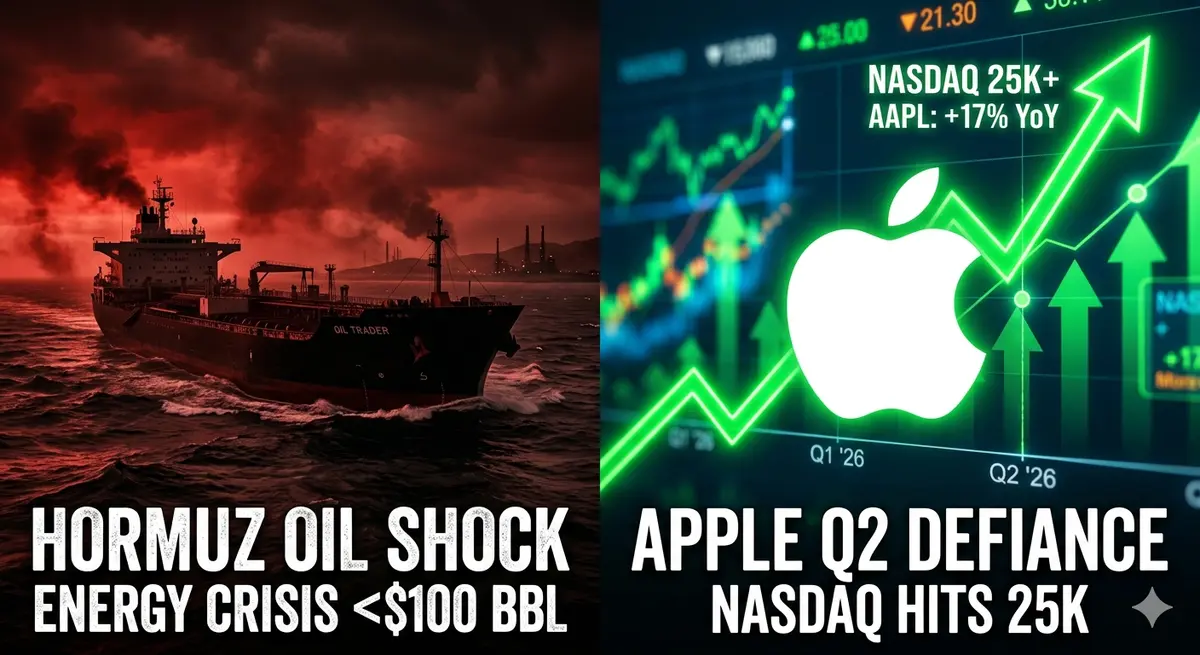
The US stock market is currently operating under a massive macroeconomic contradiction. Historically, severe geopolitical energy shocks compress corporate margins, drain consumer spending, and drag equities into deep corrections.
Yet, despite the ongoing closure of the Strait of Hormuz—which has throttled global shipping since late February and pushed Brent crude well above $100 a barrel—the market is ignoring the textbook rules. The S&P 500 just breached 7,230, and the tech-heavy Nasdaq Composite shattered the historic 25,000 ceiling.
Why is Wall Street shrugging off the largest global energy supply disruption since the 1970s? The answer lies in the “Two-Tailed Market,” where institutional capital is utilizing mega-cap tech—specifically Apple and the relentless AI infrastructure rally—as an impenetrable economic firewall.
The $100 Barrel Drag on Traditional Equities
To understand the paradox, you have to look beneath the surface of the index averages. The broader economy is undoubtedly feeling the geopolitical friction.
Since commercial shipping routes were blockaded in the Persian Gulf, energy costs have triggered a localized inflation spike. Transportation, industrial, and traditional healthcare stocks are facing severe margin compression as supply chains are forced into expensive reroutes. In a standard macroeconomic environment, this 20% global oil shortfall would immediately trigger a broad, aggressive market sell-off as analysts revise earnings forecasts downward.
Instead, institutional investors are executing a massive capital flight to safety. But rather than parking cash in traditional safe havens like gold or treasury bonds, they are pouring billions into the balance sheets of Silicon Valley.
The Apple Firewall: $111.2 Billion in 90 Days
The primary catalyst holding the entire market structure together is Apple’s staggering Fiscal Q2 performance. Just as fears regarding the Hormuz crisis peaked, Apple delivered a masterclass in corporate resilience.
The numbers are forcing analysts to completely rewrite their Q3 models:
- Record Revenue: Apple posted $111.2 billion in revenue, representing a massive 17% year-over-year growth that completely blew past the projected $109.7 billion consensus.
- The iPhone 17 Supercycle: Despite global inflation fears, hardware demand remains inelastic. The iPhone 17 lineup drove a record-breaking $57.0 billion in sales.
- Services Dominance: High-margin digital services hit an all-time quarterly high of $31.0 billion, proving that the tech giant’s software ecosystem is virtually immune to physical supply chain shocks.
Combined with a newly authorized $100 billion share repurchase program, Apple essentially signaled to Wall Street that its cash generation capabilities can outpace global inflation. Consequently, money managers are treating mega-cap tech stocks as utility-like safe havens, driving the Nasdaq past the 25,000 threshold and offsetting the deep losses in the industrial sectors.
The Q3 Risk Matrix: What Happens Next?
While the AI and semiconductor rally is currently masking the oil drag, the market is walking a tightrope.
If the “Project Freedom” maritime initiatives fail to restore commercial flow through the Strait of Hormuz, sustained $100+ crude oil will eventually erode consumer discretionary spending. The mid-cap retail and hospitality sectors are highly vulnerable over the next 90 days.
For investors, the 25K Nasdaq represents a historic milestone, but it also signals a dangerously top-heavy market. If the AI momentum cools even slightly before the geopolitical energy crisis resolves, the “tech firewall” could break, exposing the broader S&P 500 to a rapid, overdue correction.