
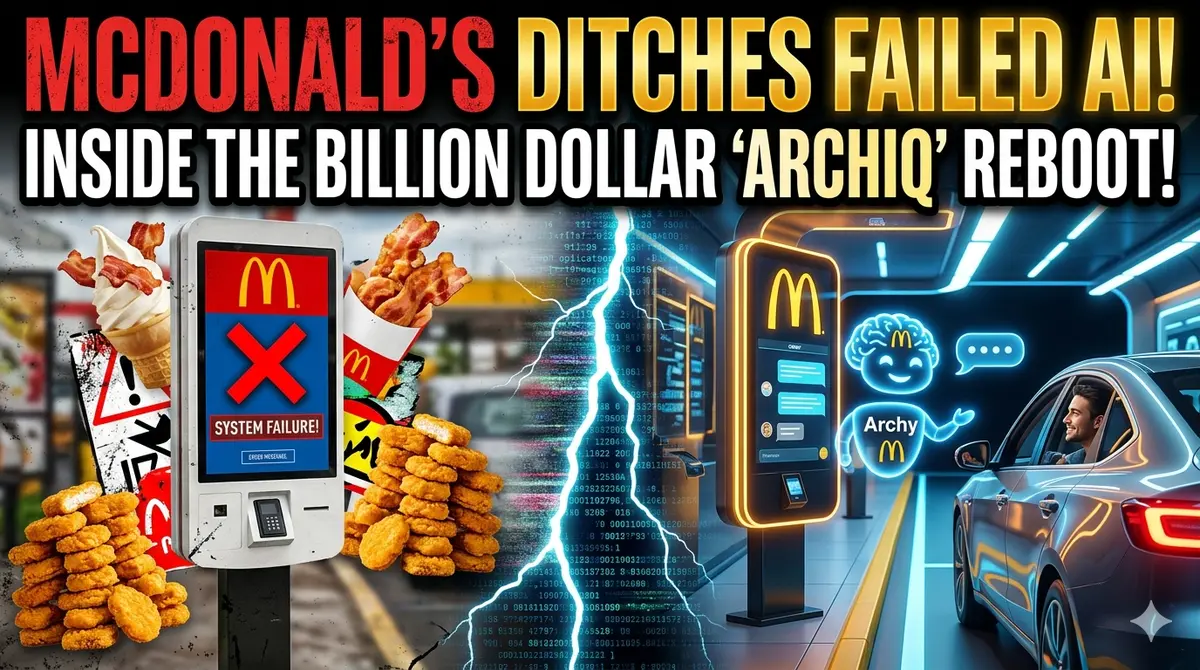
If you drove through a McDonald’s last year, you might have caught the viral videos of the Golden Arches’ disastrous first attempt at artificial intelligence. The quick-service restaurant (QSR) giant’s voice-AI trial with IBM became an internet punchline when the bot accidentally added $166 worth of chicken nuggets to an order, topped ice cream with bacon, and confused nearby car noises with actual customers.
McDonald’s quietly killed that pilot in 2024. But if you thought corporate leadership gave up on automation, think again.
At its Worldwide Convention in Las Vegas, McDonald’s unveiled its aggressive new business framework, McDonald’s Next. The crown jewel of this strategy? A massive, redesigned AI upgrade powered by Google Cloud called ArchIQ.
For finance-minded observers, this isn’t just about making sure you get the right fries—it’s a masterclass in margins, franchise labor optimization, and the future of enterprise AI monetization.
The New Playbook: Why Google is Replacing IBM
McDonald’s isn’t repeating its past mistakes. Instead of rolling out unverified tech to over a hundred stores, the company is quietly testing the new voice assistant, nicknamed “Archy,” at just five U.S. locations.
The underlying business strategy has fundamentally changed. The initial IBM trial operated as a standalone chatbot. ArchIQ, by contrast, is a holistic operating layer designed to touch every aspect of the restaurant’s P&L.
| Feature | The Old System (IBM Trial) | The New System (ArchIQ / Google) |
|---|---|---|
| Primary Focus | Standalone Drive-Thru Voice Box | Full Restaurant Connected Operations |
| Hardware Setup | Cloud-dependent (High latency) | Google Distributed Cloud Edge Hardware |
| Verification | Left to frustrated customers | Real-time human-AI verification loops |
| Scope | Order-taking only | Inventory, kitchen bottlenecks, and predictive maintenance |
By installing Google Edge Cloud hardware across the entire U.S. restaurant network ahead of the broader rollout, McDonald’s is bringing the computing power directly to the stores. This lowers latency and ensures the AI can process complex, bilingual orders (English and Spanish) smoothly.
The Finance Math: Why Franchisees Need This to Work
For McDonald’s corporate and its network of independent franchisees (who own roughly 95% of the 43,000 global locations), the push for automation isn’t a tech obsession—it’s a financial necessity.
- The Labor Crunch and Margin Compression: Labor shortages and rising minimum wages across major U.S. markets have put immense pressure on franchise operating margins.
- Automated Cross-Selling: Unlike tired human workers, an AI assistant always suggestively sells. Even a modest 2% to 4% increase in average ticket sizes via automated upselling scales into tens of millions of dollars in top-line revenue across thousands of locations.
- Throughput Efficiency: QSR value is tied entirely to speed. According to early data leaks circulating from franchised test accounts, ArchIQ has already quietly processed over one million test transactions, completing roughly 90% of orders without any human intervention.
Every second shaved off a drive-thru lane directly impacts “cars per hour” metrics, driving immediate operating leverage during high-volume breakfast and lunch rushes.
The Bottom Line for Investors
McDonald’s CEO Chris Kempczinski summed up the competitive stakes perfectly: “In a world where every restaurant is a swipe away, there is no such thing as second place.”
The initial hype of consumer-facing generative AI is officially over; we have entered the era of enterprise execution. Fast-food peers like Wendy’s, Taco Bell, and Starbucks are all piloting their own versions of predictive ordering and kitchen automation.
If McDonald’s can successfully scale ArchIQ without triggering another wave of viral customer complaints, it will set the gold standard for how legacy brick-and-mortar brands leverage tech to protect corporate margins against persistent inflationary headwinds. Source
read about Bitcoin Price Today

Sedha Patel is a personal finance strategist with over 5 years of experience analyzing consumer banking trends, liquidity management, and wealth preservation. With a professional background in accounting and corporate finance, Sedha specializes in translating macro monetary policy into practical money moves for everyday savers. When not dissecting market data, Sedha researches fixed-income allocation models and tax-advantaged investing strategies.