
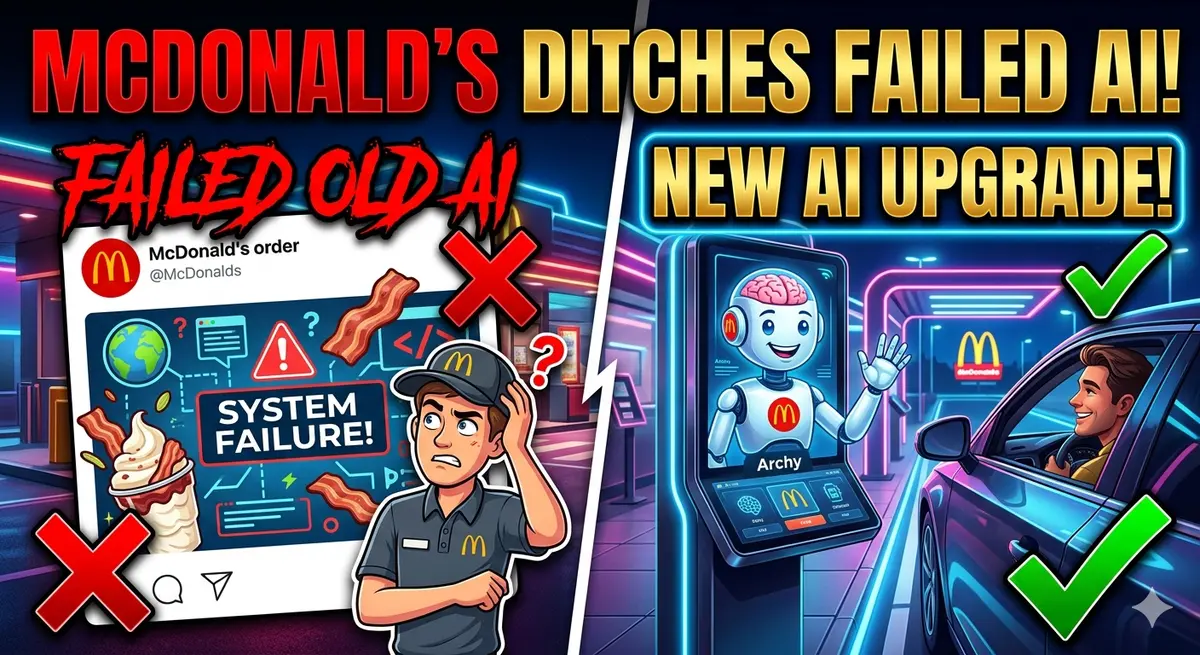
The fast-food drive-thru is officially becoming the ultimate testing ground for enterprise artificial intelligence. For anyone tracking corporate tech investments or fast-food stock trends, the phrase mcdonald’s drive-thru ai upgrade has become synonymous with a massive strategic shift in quick-service restaurant (QSR) operations.
After a highly publicized, viral stumble with its initial IBM automated order-taking pilot, McDonald’s has completely re-engineered its digital playbook. Unveiled at its Worldwide Convention in Las Vegas as part of the sweeping “McDonald’s Next” growth framework, the brand is rolling out ArchIQ—a next-generation AI operating layer developed in collaboration with Google Cloud.
Here is a look at the financial math, the new tech architecture, and why this second attempt at voice AI is designed to succeed where the previous pilot failed.
The Pivot From IBM to Google Cloud: Why This Time is Different
McDonald’s first major foray into drive-thru voice automation ended quietly in 2024. Partnering with IBM across more than a hundred test locations, the early system became an internet punchline when social media videos showed the automated voice bot misinterpreting simple orders, picking up background noise from adjacent cars, and adding dozens of unwanted items to consumer bills.
Corporate leadership didn’t abandon automation—they changed the infrastructure. Instead of relying on a standalone cloud-dependent chatbot, the new ArchIQ system treats voice-activated ordering as just one branch of a comprehensive, connected restaurant operation.
### The Power of Edge Computing
The foundational difference in this deployment lies in Google Distributed Cloud Edge hardware. Rather than sending every audio interaction to a distant remote server—which introduces latency and lag—McDonald’s is actively installing local Google Edge Cloud blades directly inside its U.S. restaurant network.
This local processing power delivers several major advantages:
- Drastically Reduced Latency: Faster response times keep the drive-thru lane moving smoothly.
- Bilingual Capability: Early test accounts indicate the voice assistant, nicknamed “Archy,” can seamlessly process orders in both English and Spanish.
- Technological Autonomy: Individual stores can maintain core automated functions even if broader network connectivity experiences a momentary hiccup.
Analyzing the Numbers: The Financial Incentives for Franchisees
For corporate headquarters and the independent business owners operating roughly 95% of McDonald’s 43,000 global stores, automation isn’t about tech novelty—it is a direct defense mechanism against macroeconomic headwinds.
Persistent inflationary pressures, rising minimum wages in key U.S. markets, and systemic labor shortages continue to squeeze historical operating margins. The financial framework backing ArchIQ targets three distinct areas of the franchise Profit & Loss (P&L) statement:
1. Throughput Speed and Efficiency
QSR revenue is inextricably linked to speed. Every single second trimmed from a drive-thru lane expands the maximum number of cars processed during peak breakfast and lunch hours. According to data leaks shared via franchised accounts on X (formerly Twitter), ArchIQ has processed over one million transactions across its initial test stores, completing roughly 90% of those orders successfully without human intervention.
2. Guaranteed Suggestive Selling
Human crew members working a stressful, high-volume shift frequently forget to cross-sell promotional items or upsell larger sizes. An AI voice model always executes its suggestive selling algorithms. Across thousands of high-traffic locations, even a fractional 2% to 4% climb in the average ticket size scales directly into tens of millions in top-line revenue.
3. Back-of-House Operational Management
Unlike the isolated IBM trial, ArchIQ is built to act as an operational assistant for restaurant managers. The system processes real-time transaction data to track kitchen activity, isolate operational bottlenecks, monitor equipment performance, and flag potential fulfillment issues before they disrupt the drive-thru lane.
What the Restraint of a 5-Store Pilot Tells Investors
Perhaps the most telling aspect of the mcdonald’s drive-thru ai upgrade is the company’s current caution. While local edge infrastructure is being placed across the country, the consumer-facing voice assistant is only active in five U.S. restaurant locations.
This disciplined pace highlights an important industry reality: consumer-facing generative AI operates under a much higher bar of customer scrutiny than back-office tools. A broken internal forecasting model harms a corporate spreadsheet; a broken drive-thru speaker box directly alienates a paying customer sitting in their vehicle.
As CEO Chris Kempczinski noted to the system during the convention, fast-food consumers in a hyper-competitive market demand both speed and hospitality, warning that “in a world where every restaurant is a swipe away, there is no such thing as second place.”
The Automated Future of Quick-Service Dining
McDonald’s is far from alone in this digital arms race. Major industry peers, including Taco Bell, Wendy’s, and Starbucks, are aggressively scaling their own versions of predictive ordering, automated drive-thru lanes, and computer-vision accuracy scales.
The true success metric for ArchIQ won’t just be how well it handles complex, customized orders over noisy engines, but how effectively it converts technology into tangible operating leverage for local operators. If McDonald’s can execute this rollout smoothly, it will solidify the enterprise blueprint for how multi-billion dollar legacy retail operations leverage artificial intelligence to protect long-term margins.

Sedha Patel is a personal finance strategist with over 5 years of experience analyzing consumer banking trends, liquidity management, and wealth preservation. With a professional background in accounting and corporate finance, Sedha specializes in translating macro monetary policy into practical money moves for everyday savers. When not dissecting market data, Sedha researches fixed-income allocation models and tax-advantaged investing strategies.