
If you are still keeping your hard-earned savings in a traditional, brick-and-mortar bank account, you are actively losing money every single month.
For the past couple of years, everyone expected interest rates to steadily drop back down to pre-pandemic levels. But the Federal Reserve just threw a wrench into those predictions. With inflation remaining stubborn and the Fed signaling a prolonged “hold” on interest rate cuts, we have officially entered a “Higher for Longer” economy.
While this is tough news for home buyers and borrowers, it has created a massive, hidden loophole for savers—but only if you know where to look.
The Massive Yield Gap Costing You Hundreds
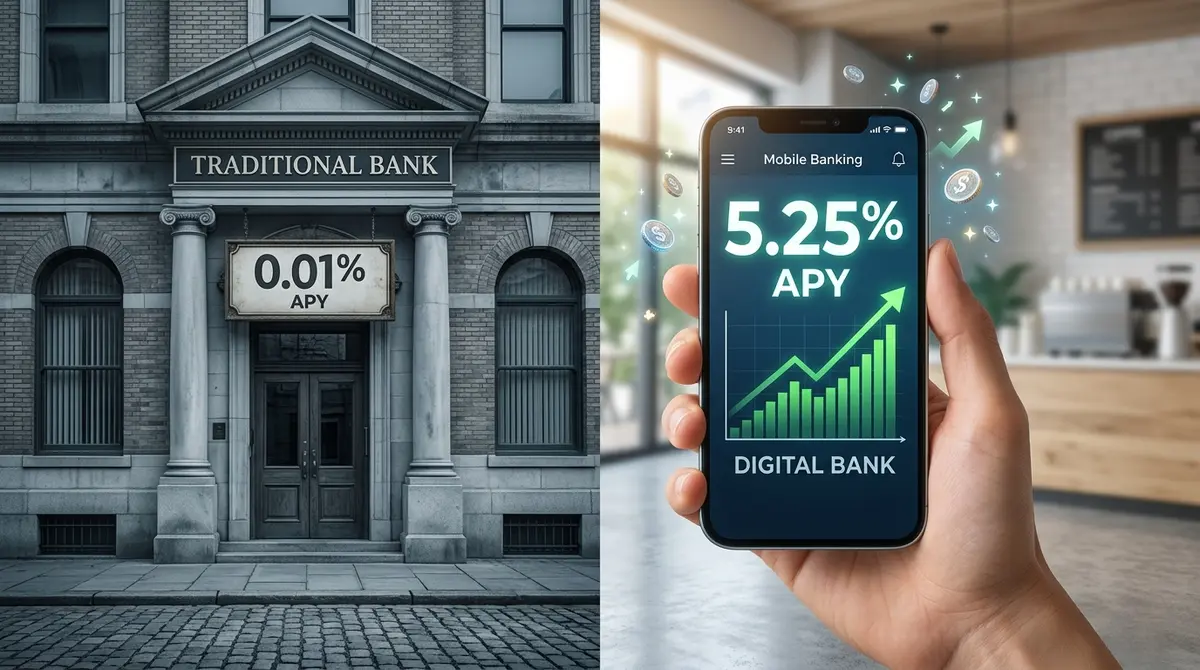
The average traditional bank in the U.S. still offers a measly 0.01% to 0.05% Annual Percentage Yield (APY) on standard savings accounts. If you have $10,000 sitting in one of these accounts, you are earning a grand total of about $5 a year. Meanwhile, inflation is quietly eroding the purchasing power of that cash.
On the flip side, select digital-first banks, localized credit unions, and short-term fixed-income instruments are currently holding their rates steady at 4.5% to over 5.0% APY.
Look at how that same $10,000 performs over twelve months when you shift it out of a traditional legacy bank:
| Account Type | Average APY | Yearly Return on $10,000 |
|---|---|---|
| Traditional Legacy Bank | 0.02% | $2.00 |
| High-Yield Digital Account | 4.75% | $475.00 |
| Top-Tier Specialized Credit Union | 5.25% | $525.00 |
The math is simple: keeping your cash in the wrong place is essentially volunteering to pay a “convenience tax” to a multi-billion-dollar banking institution.
Why the “Higher for Longer” Era Changes the Rules
In a normal economic cycle, high-yield accounts start dropping their rates the second the Fed stops hiking. However, because the economy is maintaining its current plateau, these high-yield rates are remaining sticky.
Digital banks don’t have to pay for thousands of physical branches, massive utility bills, or localized tellers. They pass those immense savings directly to you in the form of yield. Your funds remain entirely safe, protected by the exact same FDIC insurance (up to $250,000 per depositor) that the big legacy banks use. There is zero added risk; it is purely a structural advantage.
How to Capture the Extra Yield Safely
Moving your funds doesn’t mean you have to completely sever ties with your current bank. Most savers prefer a hybrid approach that takes less than ten minutes to set up:
- Keep your operational cash (about one to two months of living expenses) in your traditional checking account for easy ATM access and bill pay.
- Link a high-yield digital account to your primary bank via a secure ACH connection.
- Transfer your emergency fund or long-term cash reserves into the high-yield account to let it compound at the higher rate.
With the Fed locked into its current strategy for the foreseeable future, the gap between the financial “haves” and “have-nots” comes down to who is willing to spend ten minutes moving their money to the right side of the ledger.

sedhabhai is a financial strategist with over 5 years of experience helping people navigate the complexities of personal wealth. With a background in Investment Banking or Accounting, they specialize in breaking down high-level market trends into actionable advice for everyday savers. When they aren’t analyzing spreadsheets, you’ll find them studying . sedhabhai believes that financial freedom isn’t about how much you make, but how well you manage what you have. Contact: @finance_th94097