
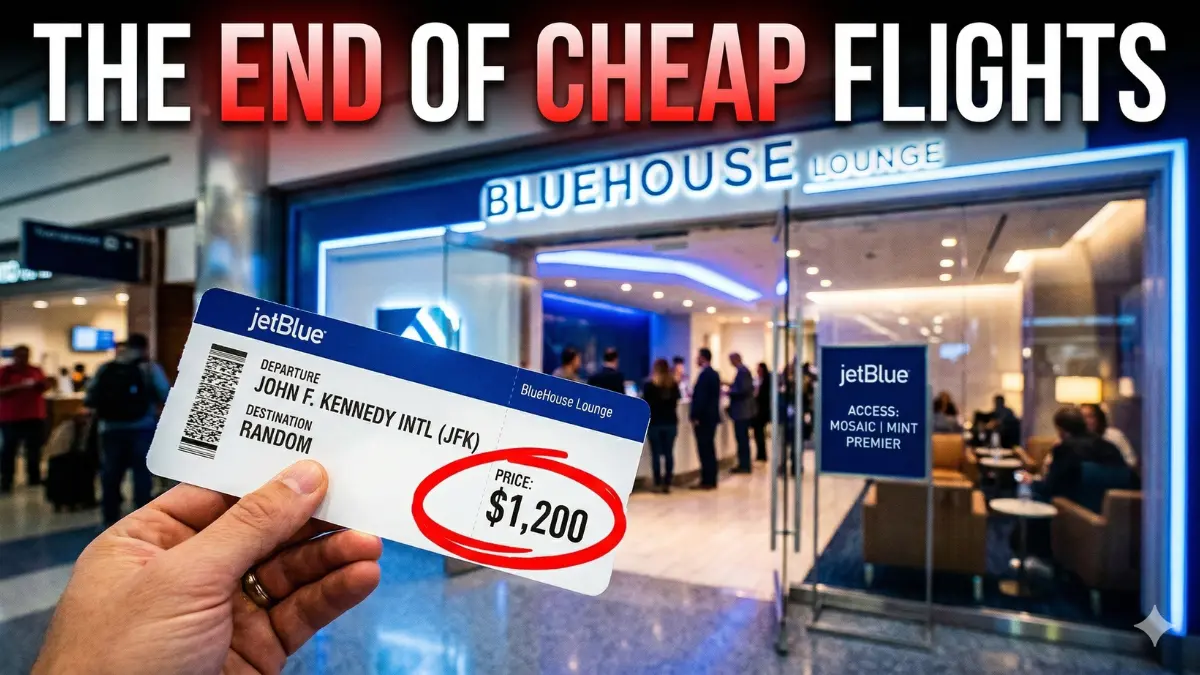
For over 20 years, JetBlue’s brand was built on a single, defiant promise: “You don’t have to be rich to fly like a human.” With the most legroom in coach, free high-speed Wi-Fi, and live TV, it was the “un-airline.”
But in 2026, that era is officially over. Facing a blocked merger with Spirit Airlines and persistent losses, JetBlue has launched “JetForward”—a ruthless strategic pivot that prioritizes high-margin premium travelers over the budget-conscious masses.
1. The Financial Catalyst: Why “Nice” Wasn’t Profitable
JetBlue found itself “stuck in the middle.” It wasn’t as cheap as Ultra-Low-Cost Carriers (ULCCs) like Spirit, yet it lacked the lucrative corporate contracts of the “Big Three” (Delta, United, American).
- The Problem: JetBlue was giving away premium perks (extra legroom, free snacks) at budget prices, but travelers weren’t paying a premium for them.
- The Math: By 2025, JetBlue’s CASM (Cost per Available Seat Mile) remained high due to its aging fleet and expensive East Coast hubs, while its RASM (Revenue per Available Seat Mile) struggled to keep pace.
2. The “Great Squeeze” of 2026
To make room for more profit, JetBlue is taking a literal page out of its competitors’ playbooks: The Squeeze.
- Shrinking Legroom: To install its new Domestic First Class (internally dubbed “Mini-Mint”), JetBlue is reducing standard coach pitch from its industry-leading 32 inches down to 30 inches.
- Segmentation: The cabin is now divided into four distinct “financial tiers”:
- Mint: Premium lie-flat suites.
- Domestic First: The new recliner-style “Junior Mint.”
- Even More Space: The only way to get the “old” JetBlue legroom (for a fee).
- Core (Economy): A standard, cramped industry experience.
3. The New Profit Engine: Lounges and Loyalty
The most visible sign of the “Death of Budget Travel” is the opening of the BlueHouse Lounges.
- JFK Terminal 5: The flagship 9,000-square-foot lounge opened in late 2025, followed by Boston (BOS) in mid-2026.
- The Business Strategy: Lounges aren’t just for comfort; they are “loyalty traps.” They are designed to drive sign-ups for high-fee Premier Credit Cards and push travelers toward Mosaic 4 status. JetBlue has realized that a traveler who pays for a $500 annual credit card is worth more than ten “one-off” budget travelers.
4. The Result: A “Boutique Premium” Airline
JetBlue is no longer trying to be the airline for everyone. Instead, it is doubling down on:
- High-Value Geography: Focusing 60% of its capacity on New York and Florida, where wealthy leisure travelers reside.
- Premium Leisure: Targeting the “Zoom Class”—people who have the money for a Mint seat but are traveling for vacation, not just business.
Key Takeaways for Business Analysts
| Old JetBlue (2000–2023) | New JetBlue (2026+) |
| Identity: Egalitarian / Low-Cost | Identity: Boutique / Premium-Leisure |
| Differentiator: Best-in-class Economy | Differentiator: Luxury Lounges & Mint |
| Strategy: Scale via Mergers | Strategy: Margin via Segmentation |
| Focus: Every Traveler | Focus: Mosaic Members & Cardholders |
The Verdict: The “Death of Budget Travel” at JetBlue is a masterclass in Value Migration. When a company can no longer compete on cost, it must innovate on “exclusivity.” For the US traveler, the “Blue” in JetBlue now stands for “Premium Blue,” not “Budget Blue.”

Sedha Patel is a personal finance strategist with over 5 years of experience analyzing consumer banking trends, liquidity management, and wealth preservation. With a professional background in accounting and corporate finance, Sedha specializes in translating macro monetary policy into practical money moves for everyday savers. When not dissecting market data, Sedha researches fixed-income allocation models and tax-advantaged investing strategies.