
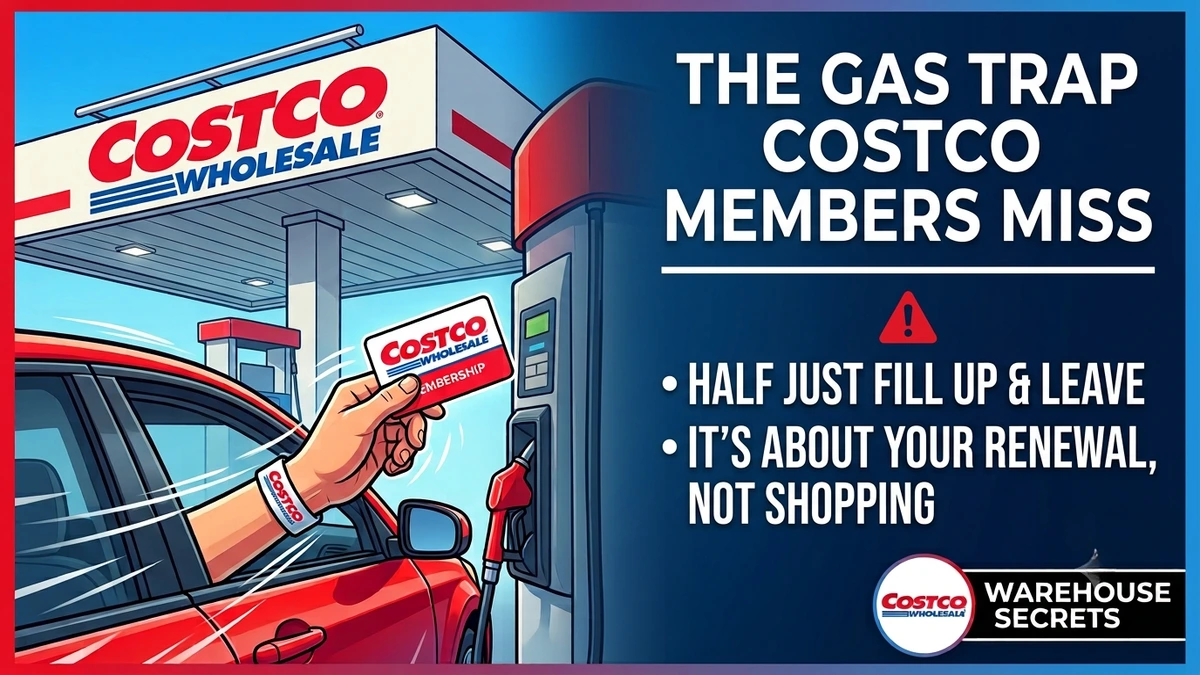
For millions of Americans, a trip to Costco isn’t complete without a stop at the warehouse’s gas station. Watching those digital numbers on the pump stay comfortably below the local street average feels like a massive financial win.
The conventional wisdom has always been simple: Costco uses cheap gas as a “loss leader”—a enticing treat to get you onto the property so you’ll head inside and drop $300 on bulk paper towels, giant jars of cashews, and a television you didn’t know you needed.
But according to Costco’s own executive leadership, that accepted narrative is completely wrong. There is a surprising move that more than half of Costco gas customers make every single time they pull up to the pump: They completely skip going inside the store.
The 50% Pump-and-Run Phenomenon
During a recent earnings call, Costco Chief Financial Officer Gary Millerchip pulled back the curtain on member behavior at the pumps. With gas volumes hitting massive numbers, the company tracked exactly how much cross-traffic the fuel stations actually generate for the main warehouse.
The results are a reality check for the traditional retail model.
”I would say that, generally speaking, a little less than half of our members are visiting the warehouse when they visit the gas station,” Millerchip revealed.
Furthermore, Millerchip noted that when gas prices fluctuate, drivers frequently stop by just to “top up” their tanks to lock in low rates. Yet, despite these more frequent visits to the parking lot, they don’t increase how often they walk through the warehouse doors.
If cheap gas isn’t actually driving immediate foot traffic to buy high-margin goods inside, why does Costco keep selling it at razor-thin margins?
Understanding the “Anti-Retail” Model
To understand why Costco isn’t panicked about millions of members buying gas and driving away, you have to understand how the company actually makes its money.
Traditional supermarkets and big-box retailers rely on merchandise margins—buying an item cheap and selling it to you for a markup. Costco operates on a fundamentally different blueprint. They don’t care about making a massive profit on a gallon of gas, or a rotisserie chicken, or even a laptop.
Costco’s actual product is its membership card
| The Costco Revenue Reality | |
|---|---|
| Membership Fee Income | $1.37 Billion (Q3 alone, up 10.7% year-over-year) |
| Profit Margin Focus | Membership fees are essentially 100% pure profit. |
| The Strategy | Merchandise is sold at near-cost purely to justify the annual fee. |
Because membership fees fund the vast majority of Costco’s bottom line, the company doesn’t judge the success of its gas stations by how many hot dogs or bulk goods you buy afterward. They judge it by loyalty.
Why the “Gas Trap” Works Perfectly
When you pull away from a Costco fuel pump having saved $5 to $10 on a single fill-up, a psychological switch flips. You instantly calculate how many fill-ups it takes to pay off your annual $65 or $130 membership fee.
Costco knows this. The cheap gas isn’t a trap to get you to buy a warehouse cart full of groceries today; it’s a retention tool to ensure you eagerly pay your renewal fee next year.
”We do think over time, it is a great way to build loyalty,” CFO Millerchip explained. “When we look at our members that are engaged in gas with us, they are generally visiting more frequently overall… and they are also renewing at a higher rate.”
So the next time you wait in a 15-minute line for Costco gas, fill up your tank, and drive straight out of the parking lot without stepping foot inside the warehouse, don’t feel guilty. You aren’t beating the system—you are executing Costco’s business model exactly as they planned.

Sedha Patel is a personal finance strategist with over 5 years of experience analyzing consumer banking trends, liquidity management, and wealth preservation. With a professional background in accounting and corporate finance, Sedha specializes in translating macro monetary policy into practical money moves for everyday savers. When not dissecting market data, Sedha researches fixed-income allocation models and tax-advantaged investing strategies.