
The 4% Savings Trap Costing Savers Thousands
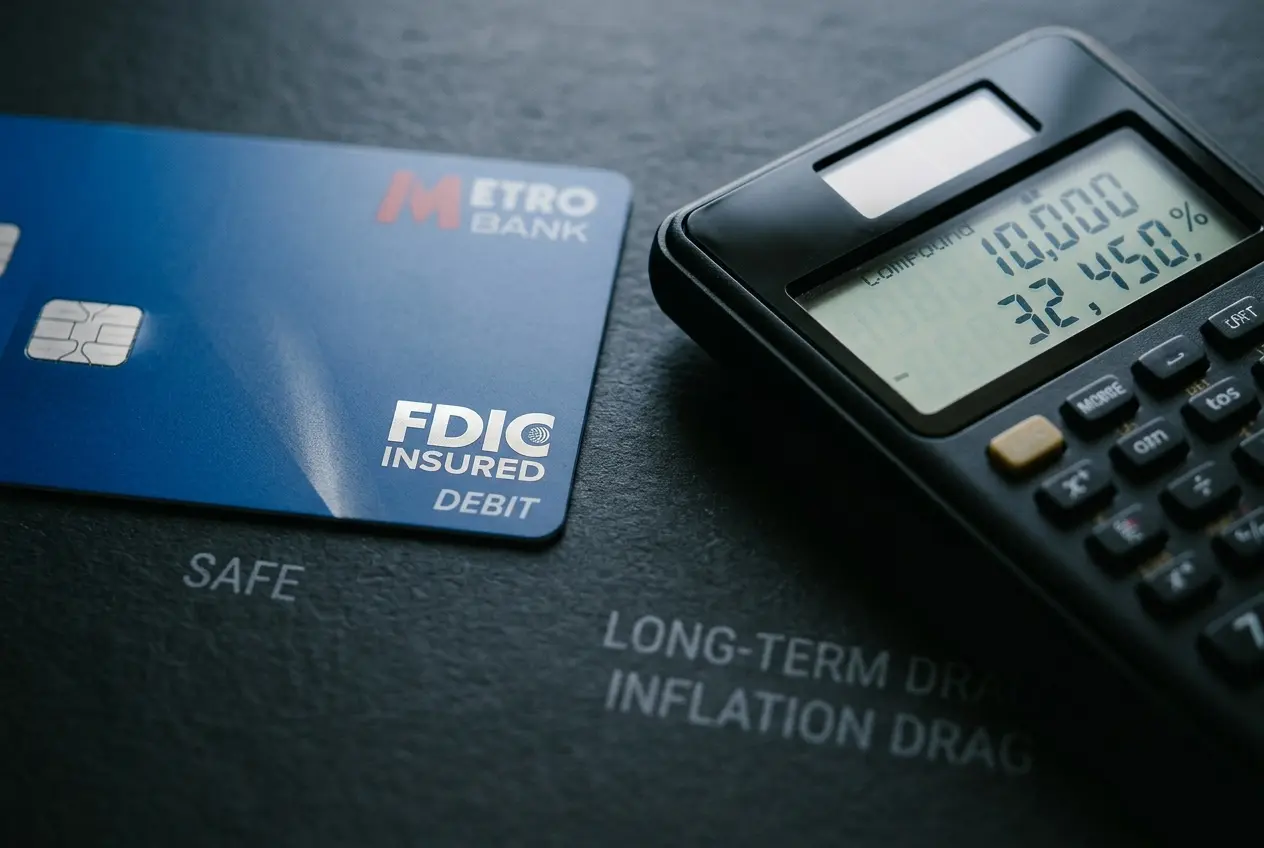
Parking your emergency fund in a High-Yield Savings Account (HYSA) felt like a masterstroke over the last few years—and for cash you need tomorrow, it still is. But treating an FDIC-insured savings account like a long-term wealth engine is quietly draining your future net worth every month you leave extra dollars untouched.
When high annual percentage yields (APYs) first returned to banking apps, earning 4% or 5% on idle cash felt like free money after a decade of near-zero returns. Today, millions of Americans have fallen into a comfortable psychological trap: hoarding tens of thousands of dollars in cash reserves because seeing a guaranteed deposit hit every month feels safer than investing it.
That sense of safety comes with a hidden invoice.
The “Comfort Tax”: Why Cash Drag Hits Harder Than You Think
A High-Yield Savings Account protects your nominal principal—your $10,000 will never become $9,500 due to a bad trading day. What it cannot protect is your actual purchasing power once taxes and inflation collect their share.
Most savers forget that HYSA yield is taxed at ordinary income rates, not the lower long-term capital gains rate. If your account pays 4.2% APY and you sit in the 22% federal tax bracket, your real yield drops to roughly 3.28% before state taxes even register. If core inflation hovers around 2.5% to 3%, your real, inflation-adjusted return is barely scraping positive territory.
Meanwhile, the Federal Reserve adjusts benchmark interest rates over time. Unlike Certificates of Deposit (CDs) or fixed-income bonds, high-yield savings accounts carry variable rates—meaning your bank can slash your APY overnight without warning.
Running the Numbers: The Real Cost of “Too Safe”
Consider two 35-year-old savers, Marcus and Elena. Both saved a robust $30,000 above their core emergency cushion over the past five years.
- Marcus leaves his $30,000 in an HYSA, averaging a hypothetical 4.0% APY over the next 15 years.
- Elena keeps her core safety net in cash, but moves that excess $30,000 into a low-cost S&P 500 index fund inside a tax-advantaged account, averaging a historical conservative return of 7.5% annualized after accounting for market dips.
The difference between these two strategies is over $34,000 on a single upfront balance—more than the original principal itself. That gap is the opportunity cost of mislabeling long-term money as short-term liquidity.
How Much Cash Is Actually “Too Much”?
Financial advisors generally recommend keeping three to six months of essential living expenses in an easily accessible, FDIC-insured account. For single-income households or freelancers, extending that buffer to nine or twelve months makes practical sense.
Everything beyond that reserve, however, is subject to aggressive cash drag if left parked.
Rule of Thumb: If a dollar has a specific job inside the next 18 to 24 months (e.g., buying a car, putting a down payment on a home, or paying estimated taxes), keep it in cash or short-term Treasuries. If that dollar’s job isn’t needed for three to five years or longer, leaving it in an HYSA is essentially paying a hefty premium for emotional comfort.
4 Moves to Put Excess Cash Back to Work Today
Transitioning surplus cash doesn’t mean gambling on speculative stocks or locking your money away forever. Here are four structured, low-stress adjustments you can make this week:
1. Calculate Your Exact “Sleep-at-Night” Number
Audit your actual baseline monthly burn rate—housing, debt minimums, groceries, utilities, and essential insurance. Multiply that number by four to six months. Lock that amount in your HYSA, label it “Core Emergency Fund,” and mentally consider it off-limits for optimization.
2. Max Out Tax-Advantaged Buckets First
Before opening a standard taxable brokerage account, evaluate whether your long-term retirement accounts are filled. For eligible earners, contributing to an employer 401(k) up to the match is an automatic 100% return on those dollars. From there, funding a Roth IRA or Health Savings Account (HSA) allows your surplus cash to compound without a yearly tax drag on interest.
3. Lock In Guaranteed Yield with Treasuries or CDs
If you have cash designated for a medium-term goal—like a wedding or house down payment in 2028—an HYSA leaves your yield exposed to Federal Reserve rate cuts. Consider low-risk vehicles like Treasury bills or fixed-rate CDs, which lock in your yield regardless of what the central bank does next.
4. Dollar-Cost Average (DCA) into Broad Index Funds
Moving a lump sum of $15,000 or $25,000 into the market all at once can feel unnerving, especially when headlines are volatile. Set up an automatic weekly or bi-weekly transfer from your HYSA into a broad-market total stock index or ETF. Spreading the entries over 6 to 12 months removes emotional timing from the equation.
Finding Your Personal Balance
Optimizing your finances isn’t about chasing the highest paper return at the expense of your peace of mind. If keeping nine months of living expenses in an HYSA helps you sleep soundly through unexpected job market changes, that security has genuine value.
The goal is intentionality. High-yield savings accounts remain one of the finest cash management tools ever created for everyday Americans. Just make sure your emergency buffer hasn’t quietly turned into a parking lot for your long-term financial freedom.
Disclaimer: This article is for educational and informational purposes only and does not constitute personalized financial, tax, or legal advice. Interest rates, tax brackets, and market conditions fluctuate regularly. Consult a qualified, fiduciary financial advisor or CPA to assess your specific situation before making major asset allocation shifts.

Sedha Patel is a personal finance strategist with over 5 years of experience analyzing consumer banking trends, liquidity management, and wealth preservation. With a professional background in accounting and corporate finance, Sedha specializes in translating macro monetary policy into practical money moves for everyday savers. When not dissecting market data, Sedha researches fixed-income allocation models and tax-advantaged investing strategies.